Language apps changed a lot in the last year:
- AI conversation tutors went mainstream.
- Duolingo moved its AI features around.
- Rosetta Stone launched a brand-new app.
- Anki, the classic flashcard program, changed hands.
So here's an updated guide. We've sorted the apps by what they're best for, because the best app is the one that matches your goal.
A note on bias: Karteto is our app, so of course it's on the list. We've tried to be fair to everyone else. Most people do best with two apps anyway: one for vocabulary, one for speaking.
Quick picks
| If you want… | Try |
|---|---|
| To build vocabulary with pictures, a few minutes a day | Karteto |
| A free, game-like daily habit | Duolingo |
| Structured lessons with clear grammar explanations | Babbel or Busuu |
| To practise speaking with an AI tutor | Speak or Praktika |
| To learn mainly by listening, for example while driving | Pimsleur |
| To learn from real articles, books and podcasts | LingQ |
| Full control over your own flashcards | Anki |
| Conversations with real people | HelloTalk, Tandem or italki |
Prices below are US App Store prices in October 2026. They vary by country and change often, and most apps run regular discounts.
Karteto
Best for: building a big vocabulary, fast, with pictures.
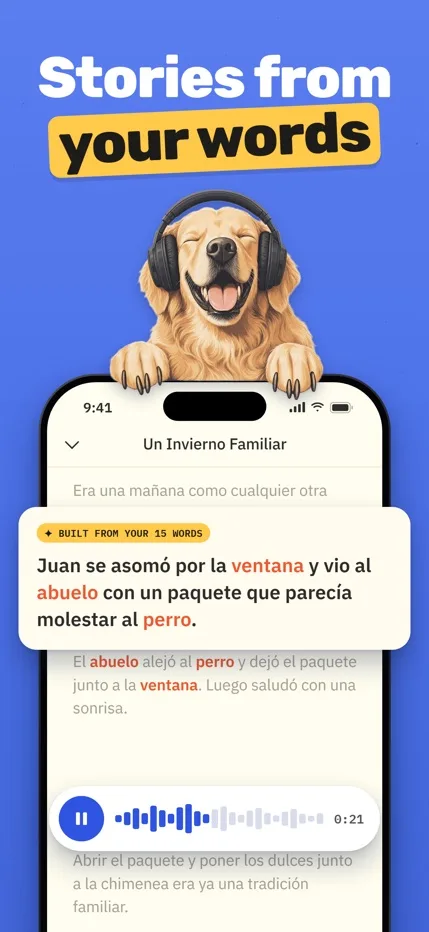
Karteto turns every word into an illustrated flashcard, with an example sentence and audio, and uses spaced repetition to bring each word back right before you'd forget it. It also writes short stories from the words you're learning, so you meet them again in context. It works with 100+ languages, has ready-made decks to start with, and lets you add any words you like.
- Good: fast, visual and focused on the words you actually need; works in 10 minutes a day
- Keep in mind: it's a vocabulary app, so pair it with a conversation partner or tutor for speaking practice
- Price: free with ads; Premium removes ads and unlocks all features, with weekly, monthly, annual and lifetime plans
Duolingo
Best for: a free, fun daily habit.
The most popular language app in the world, built around short game-like lessons, streaks and leagues, in dozens of languages. In 2026 Duolingo made "Explain My Answer" free for everyone. It has also said it's moving Video Call, its AI conversation feature, into its Super plan and may phase out the separate Max plan.
- Good: genuinely motivating, a generous free version, a huge range of languages (plus maths, music and chess)
- Keep in mind: progress can feel slow for adults who want to hold real conversations; the games can reward streaks more than learning
- Price: free with ads; Super from $12.99 a month or about $84 a year
Babbel
Best for: structured lessons with clear grammar.
Babbel's courses are written by language teachers and built around realistic dialogues, with grammar explained along the way. It's particularly strong for European languages. An AI conversation partner, Babbel Speak, is in beta.
- Good: well-organised lessons that build on each other; useful everyday phrases
- Keep in mind: fewer languages than some rivals; less game-like, so it needs a bit more self-discipline
- Price: about $17.99 a month or $107.99 a year for all languages; a lifetime plan is also available
Busuu
Best for: lessons with feedback from native speakers.
Busuu combines structured lessons with a community feature: you write or record answers, and native speakers of that language correct them. Its owner, Chegg, has made Busuu a central part of its business, so it's well supported.
- Good: real feedback on your writing and speaking; courses aligned to CEFR levels
- Keep in mind: the community features are only as good as the people who answer
- Price: free version; Premium and Premium Plus subscriptions
Speak
Best for: speaking practice with an AI tutor.
Speak is built around talking. You practise out loud with an AI tutor that responds to what you say and corrects you, so you get hundreds of speaking repetitions without the nerves of a real conversation.
- Good: lots of speaking practice; good for building confidence
- Keep in mind: only a handful of languages
- Price: about $17.99 a month or $83.99 a year; Premium Plus costs more
Praktika
Best for: chatting with an AI avatar tutor.
Praktika gives you AI tutors with faces and personalities to talk to, with lessons shaped around your goals and interests. It feels closer to a video call than a textbook.
- Good: friendly, conversational, available any time
- Keep in mind: AI tutors can still make mistakes, and it covers fewer languages than the big course apps
- Price: from about $9.99 a month or $119.99 a year
Pimsleur
Best for: learning by listening.
Pimsleur's audio lessons have you listen, repeat and answer out loud. It's great for commutes, walks and anywhere you can't look at a screen. It covers 51 languages and is testing an AI conversation coach.
- Good: builds pronunciation and listening; easy to fit into dead time
- Keep in mind: less reading and writing; a slower pace for vocabulary
- Price: All Access about $20.99 a month
Rosetta Stone
Best for: full immersion, without translations.
Rosetta Stone teaches through pictures and the target language only, with no translations. In 2026 it launched a new app, Rosetta Stone Sapphire, for new learners; the older app continues for existing subscribers. It covers 25 languages and has a 7-day free trial.
- Good: you start thinking in the language from day one; strong pronunciation feedback
- Keep in mind: without translations, beginners can sometimes guess wrong
LingQ
Best for: learning from real content.
LingQ turns articles, podcasts, YouTube videos and books into lessons. You read and listen, tap unknown words to save them, and watch your known-word count grow. It now includes AI features that can simplify texts and answer questions.
- Good: endless real material at your level; great once you know the basics
- Keep in mind: better for intermediate learners than complete beginners
- Price: Premium about $14.99 a month or $119.99 a year
Anki
Best for: total control over your flashcards.
Anki is the classic spaced-repetition program, loved by medical students and serious language learners. You can build any card you like or download shared decks. In 2026 its creator handed day-to-day running of the project to AnkiHub; the core app stays open source.
- Good: extremely powerful and flexible; free on computer and Android
- Keep in mind: you'll spend time setting it up and making cards; it doesn't teach you which words to learn
- Price: free on computer and Android; AnkiMobile for iPhone costs $24.99 once
Clozemaster
Best for: intermediate learners who want more reading practice.
Clozemaster shows you real sentences with one word missing, sorted by how common the word is. It's a fast way to meet thousands of words in context once you've finished a beginner course.
- Good: huge amounts of sentence practice; many language pairs
- Keep in mind: not designed for complete beginners
- Price: free version; Pro from about $8.99 a month
Drops
Best for: quick visual vocabulary games.
Drops teaches words through fast, colourful five-minute games. It's now part of Kahoot!.
- Good: beautiful, quick and fun
- Keep in mind: the free version limits how much you can learn each day
- Price: free version; Premium subscription
HelloTalk, Tandem and italki
Best for: conversations with real people.
No app can replace talking to a person.
- HelloTalk and Tandem connect you with native speakers who want to learn your language. You help each other, by text, voice or video. Both are free, with paid plans for extras (HelloTalk VIP is about $12.99 a month).
- italki connects you with professional teachers and community tutors for paid one-to-one lessons. Each tutor sets their own price, and there's a new italki Plus subscription with extras.
Our guide on how to find a language partner has tips for getting the most out of them.
One to watch: Google Translate's Practice mode
Google added a free practice feature to Google Translate in a 2025 beta, with short listening and speaking exercises tailored to your level. It's early days, but worth knowing about if you already use Translate.
How to choose
- Start with your goal. Travel phrases, an exam, conversation, or reading? Use the quick picks above.
- Combine two apps. One for vocabulary or lessons (Karteto, Duolingo, Babbel), one for speaking (Speak, Praktika, or a real tutor).
- Pick something you'll open every day. The best app is the one you actually use. Ten minutes daily beats an hour now and then. Here's how to learn a language in 10 minutes a day.
- Use the free trials. Most apps have a free version or trial, so try two or three for a week before you pay.
Looking for a fast way to build the vocabulary you need? Download Karteto and start with your first ten words today.