

Ten minutes a day sounds too small to matter. It's less time than most people spend choosing what to watch in the evening. But when it comes to remembering new words, a short session every day usually does more than a long session once a week.
Here's why, and exactly how to spend those ten minutes.
Why 10 minutes a day works
Your brain remembers better when practice is spaced out. Psychologists have known this since Hermann Ebbinghaus measured his own forgetting in the 1880s. A large review of hundreds of experiments (Cepeda and colleagues, 2006) confirmed it: the same amount of study, spread over several days, leads to much better long-term memory than cramming it into one sitting. For vocabulary, ten minutes on seven days will usually stick better than seventy minutes on a Sunday.
Remembering is the exercise. Re-reading a word list feels productive, but trying to recall a word is what makes it stick. In a well-known study, Roediger and Karpicke (2006) found that students who tested themselves remembered far more a week later than students who simply studied the material again. Flashcards are built on exactly this: you see the picture or the word, you try to remember, then you check.
Small habits survive busy weeks. An hour-long study plan collapses the first time life gets busy. Ten minutes fits into a coffee break, a commute or the wait for the kettle. And because it's small, you're far more likely to still be doing it in three months.
It adds up. Ten minutes a day is more than 60 hours a year. If you learn just five new words a day, that's over 1,800 words by the end of the year — enough to understand most everyday conversation.
Your 10-minute routine
Use the same four steps every day. You'll stop wondering what to do, and simply start.
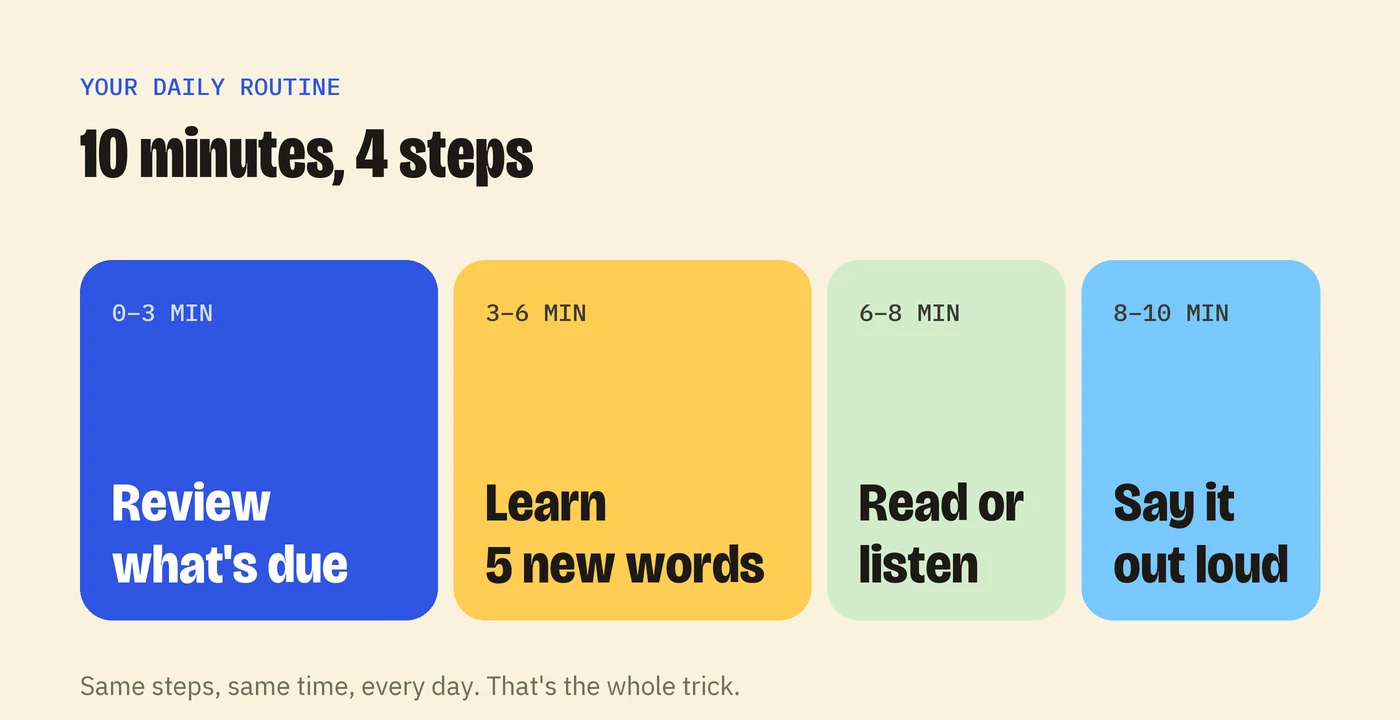
Minutes 0–3: review what's due
Start with the words you've already met. A spaced-repetition app decides which words are about to slip from your memory and shows those first, so these three minutes go where they help most. Answer honestly: if you hesitated, mark it as hard. The app will bring it back sooner.
Never skip this step to rush to new words. Reviews are what turn "I've seen this word" into "I know this word".
Minutes 3–6: learn five new words
Pick a handful of new words — five is plenty — and learn each one with:
- a picture, because images are easier to remember than translations
- an example sentence, so you see the word in use
- the audio, so you learn the pronunciation from the start
Choose words you'll actually use: things from your day, your job, your hobbies, or your next trip. Our guide on what to include on a flashcard goes into more detail.
Minutes 6–8: read or listen
Now meet your words again in context. Read a short text or listen to a short story that uses them. It's one of the best ways to move words from "recognise on a card" to "understand in real life". Even two minutes is enough to give your new words a second, different encounter.
Minutes 8–10: say it out loud
Finish by producing something. Say each new word out loud in a sentence of your own, or type one short sentence about your day. It feels awkward at first, which is exactly why it helps: speaking is a separate skill from recognising. For more ideas, see how to start speaking in a foreign language.
How many new words a day?
Start with five new words a day, and only raise it once your daily reviews feel comfortable.
The reason is simple: every new word comes back for review several times over the following days and weeks. Twenty new words today means a pile of reviews next week. The manual for Anki, a popular flashcard program, gives a useful warning: twenty new cards a day can add up to around 200 reviews a day once they start coming back. If your reviews start taking more than half of your ten minutes, pause new words for a day or two and let them settle. Slow and steady really does win here.
Make it automatic
Motivation fades. Habits don't. A few tricks make the ten minutes happen on their own:
- Attach it to something you already do. "After my first coffee" or "when I sit down on the train" works better than "sometime today".
- Same time, same place. Researchers at University College London (Lally and colleagues, 2010) followed people building a new daily habit. It took a median of 66 days for the habit to feel automatic, and the estimates varied hugely from person to person — from 18 to 254 days. Keeping the cue the same helps.
- Set a reminder for the time you chose, and keep the app on your home screen.
- Have a two-minute version for bad days. Too tired? Do just the reviews. A small session keeps the habit alive.
- Don't panic if you miss a day. The same study found that missing a single day didn't really affect how the habit formed. Just don't miss two in a row.
What 10 minutes can't do
Ten minutes a day will build your vocabulary, your reading and your listening. It won't, on its own, make you comfortable in a real conversation — that needs practice with other people. Once the daily habit is solid, add one longer session a week: a chat with a language partner, a lesson with a tutor, or an episode of a series in your target language (here's how to learn with music, films and podcasts).
Think of the ten minutes as the foundation. Everything else is built on it.
Do your 10 minutes with Karteto
Karteto is designed for exactly this routine:
- Picture flashcards for every word, with example sentences and audio
- Built-in spaced repetition that shows you the right words to review each day
- Short stories made from the words you're learning, to read and listen to
- A daily reminder at the time that suits you
- 100+ languages, with ready-made word decks to get you started
Download Karteto, set your reminder, and do your first ten minutes today.