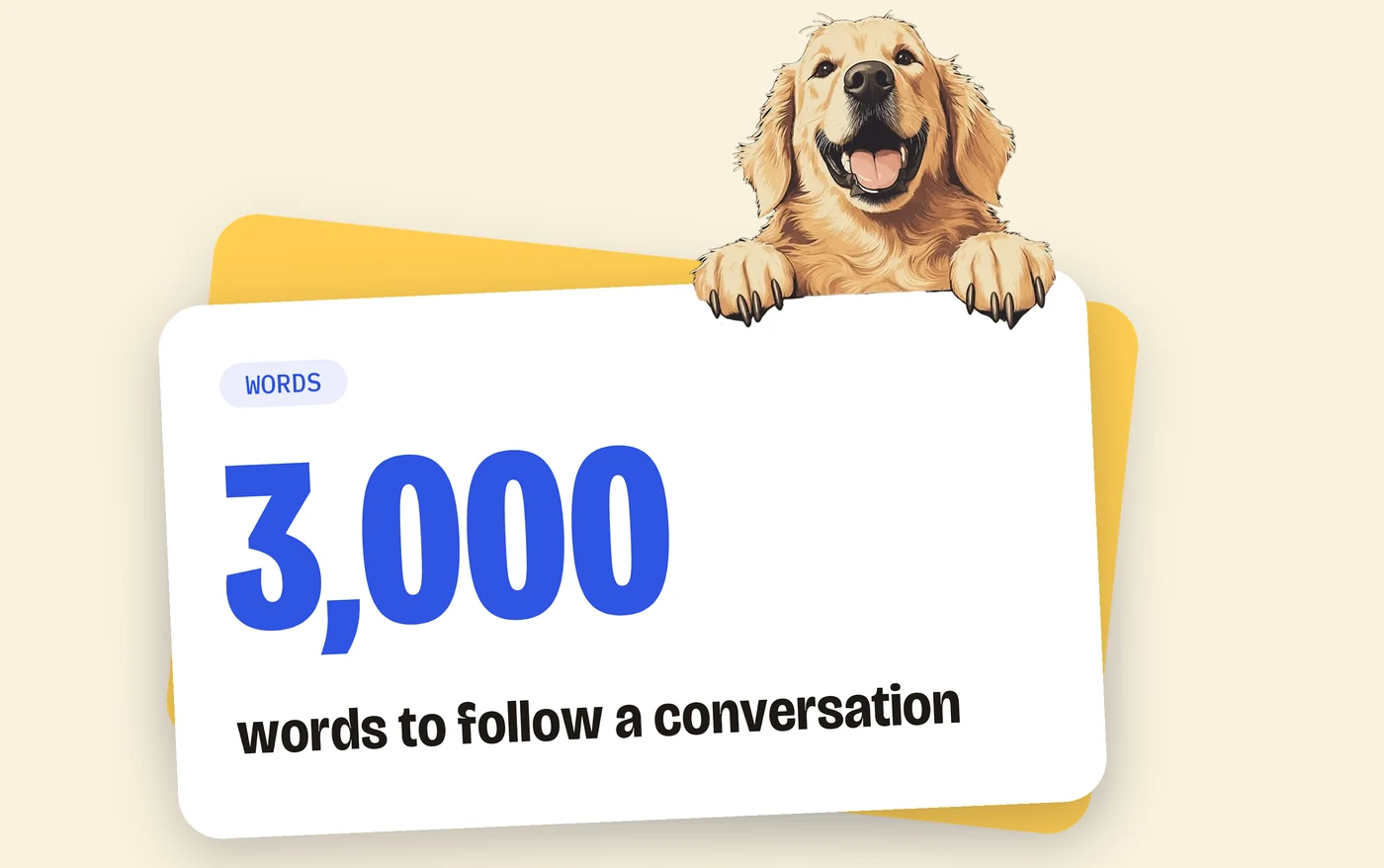
The short answer: about 1,000 words to get by, around 3,000 to follow most everyday conversations, and 8,000 or more to read novels comfortably. For comparison, a well-educated adult native speaker knows roughly 20,000 word families.
That last number can feel scary. The good news is that you don't need anywhere near it to start speaking. Here's what the research says, and how to use it.
First: what counts as a "word"?
Researchers rarely count single words. They count word families: a base word plus the words built from it. Paint, painter, painted and painting are one family. A smaller unit, the lemma, groups a word with its grammatical forms, such as Spanish pintar, pinto and pintamos.
This matters because "3,000 words" can mean very different amounts of learning depending on what's counted. All the numbers below are word families unless we say otherwise, and most come from research on English.
The numbers at a glance
| Your goal | Roughly how many words | What it gets you |
|---|---|---|
| Get by | 1,000 | About 85% of the words in everyday conversation |
| Follow most conversations | 3,000 | About 95% of the words in informal speech |
| Talk comfortably | 6,000–7,000 | About 98% of spoken language |
| Read novels and newspapers with ease | 8,000–9,000 | About 98% of written text |
| Educated native speaker | About 20,000 | Pretty much everything |
The figures come from the linguist Paul Nation (2006) and from Laufer and Ravenhorst-Kalovski (2010).
The first 1,000 words do most of the work
Languages are very uneven. A small number of words — the, be, have, go, good, time — appear constantly, while most words are rare. That's why the first 1,000 most frequent word families already cover around 85% of everyday spoken language.
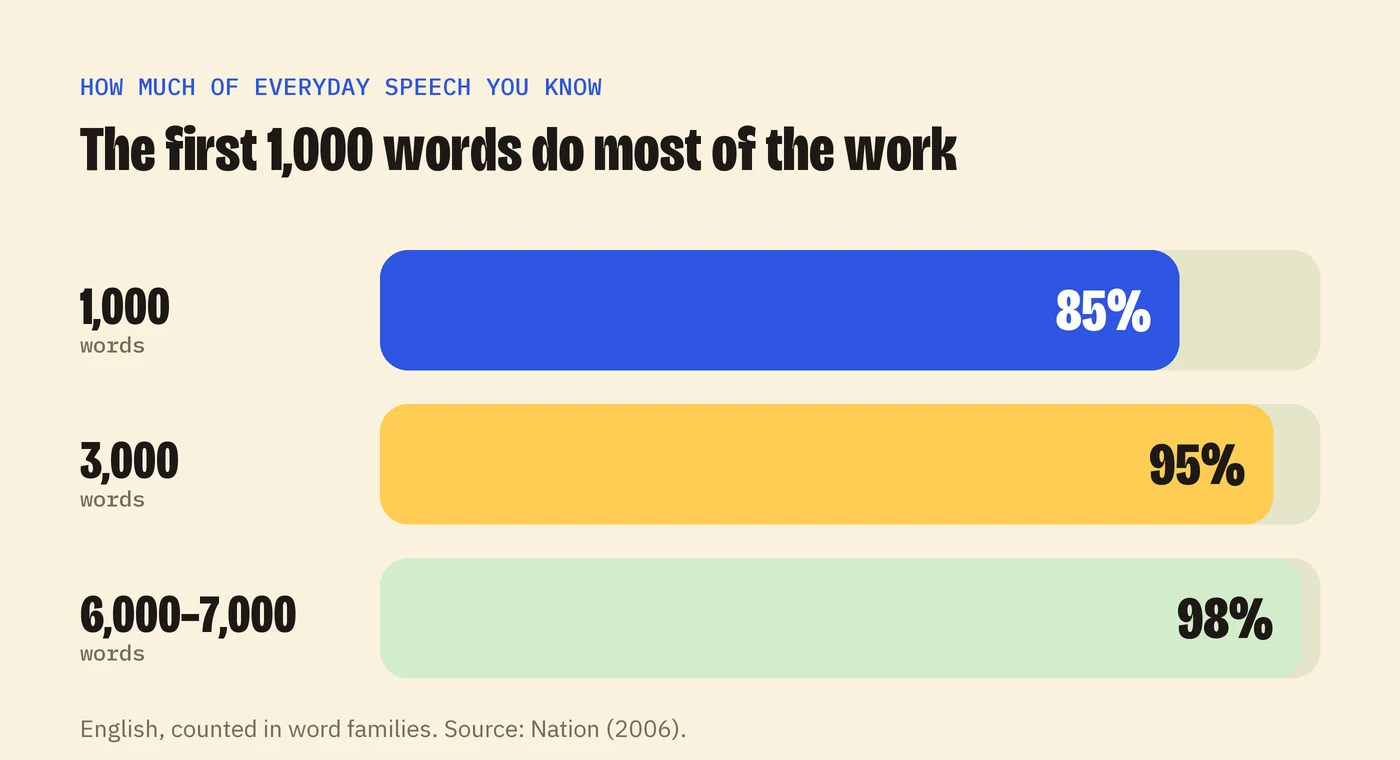
After that, each extra thousand words adds less. Going from 1,000 to 3,000 words takes you from 85% to about 95%. Getting from 95% to 98% takes several thousand more. So the first 1,000 words are the best investment you'll ever make in a language, and they're where to start.
Why 95% and 98% matter
Coverage sounds abstract, so think of it like this:
- At 85%, roughly one word in seven is new to you. You catch the topic and simple sentences, but you miss a lot.
- At 95%, about one word in twenty is unknown. You can follow the conversation and guess most gaps from context. Researchers treat this as the minimum for understanding a text.
- At 98%, only one word in fifty is new. This is where reading and listening start to feel comfortable, and where you start picking up new words naturally, just from context.
How many words for each CEFR level?
Language courses and exams use the CEFR scale, from A1 (beginner) to C2 (mastery). Researcher James Milton tested learners of English with a vocabulary test that covers the 5,000 most common words, and found these typical ranges (counted as lemmas):
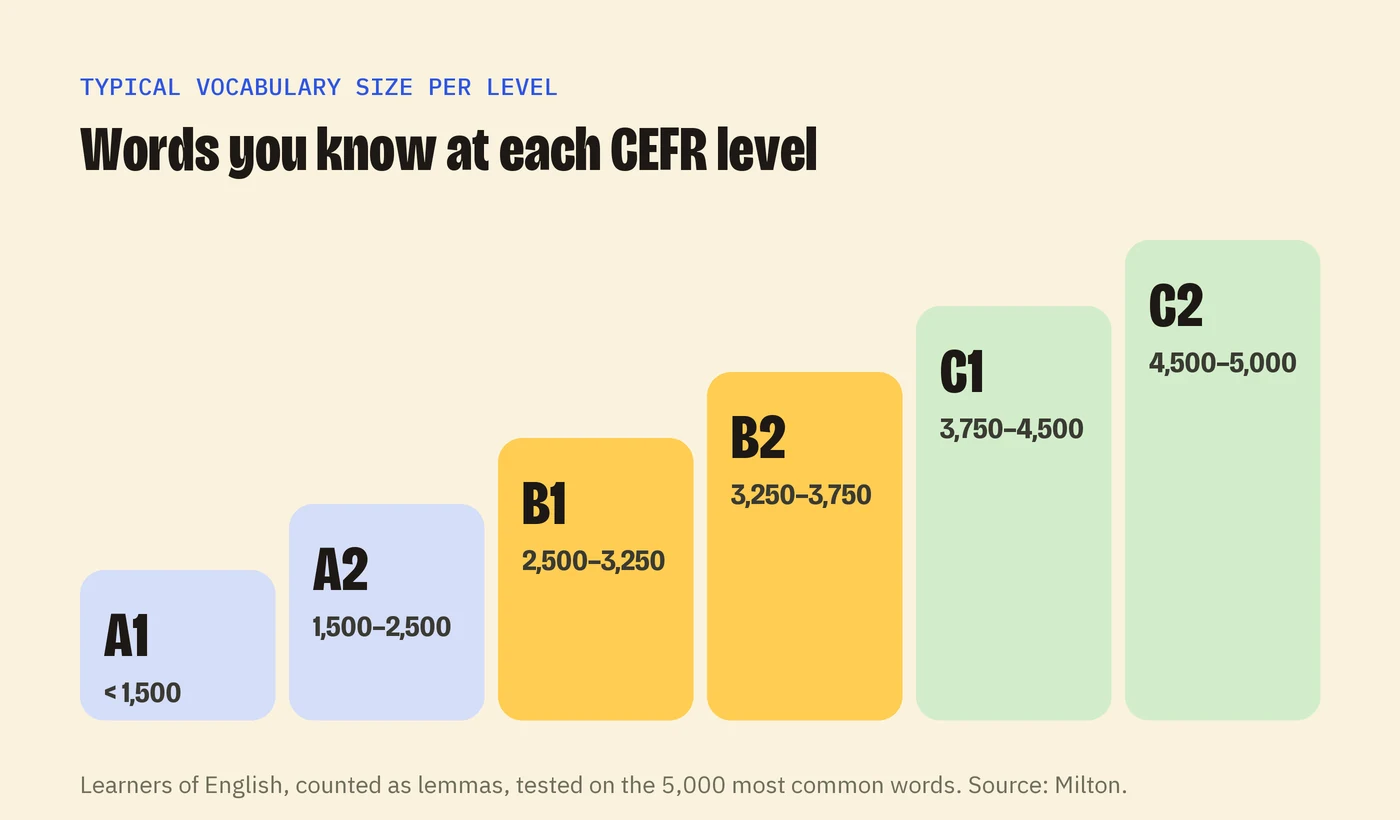
Take these as a rough guide, not a target. They come mostly from learners of English in Greece. Because the test stops at 5,000 words, real C1 and C2 learners often know more — Paul Nation suggests about 5,000–6,000 words for C1 and 7,000–9,000 for C2.
Does this work for other languages?
Most of this research is on English, but other languages show a very similar pattern:
- Spanish: the 1,000 most common lemmas cover about 88% of spoken Spanish, and the top 3,000 about 94% (Mark Davies, 2005).
- German: the top 2,000 lemmas cover about 87% of spoken German (Jones, 2003).
- French: the 2,000 most common word families cover roughly 85% of texts (Cobb and Horst, 2004).
In every language, a few thousand frequent words carry most of everyday communication. Languages with lots of word endings, such as Finnish or Russian, have more forms to learn per word, so expect them to feel bigger.
So how many words should you learn?
Start with the 1,000 most common words. They give you the biggest return, fast. Our list of 100 must-know words is a good first step.
Then add your own words. Frequency lists don't know your life. If you're a nurse, a gamer or a keen cook, the words you need most won't all be in the top 3,000. Learn the words you'll actually say.
Aim for 3,000 to hold real conversations. This is the point where the language starts to feel usable, and where reading and listening begin to teach you new words by themselves.
Learn them so they stick. Seeing a word once doesn't mean you know it. Learn each word with a picture and an example sentence, then review it at growing intervals with spaced repetition. There are more tips in our guide to remembering new words.
How long does it take? At five new words a day, you'll know 1,000 words in about seven months, and at ten a day in just over three. That's about ten minutes a day.
Learn your first 1,000 words with Karteto
Karteto turns this into a daily habit:
- Picture flashcards for every word, with example sentences and audio
- Ready-made word decks to start with, plus any words of your own
- Spaced repetition that brings each word back right before you'd forget it
- Short stories made from the words you're learning
- 100+ languages
Download Karteto and learn your first ten words today.